
Is Foundation: Galactic Frontier worth playing in 2026?
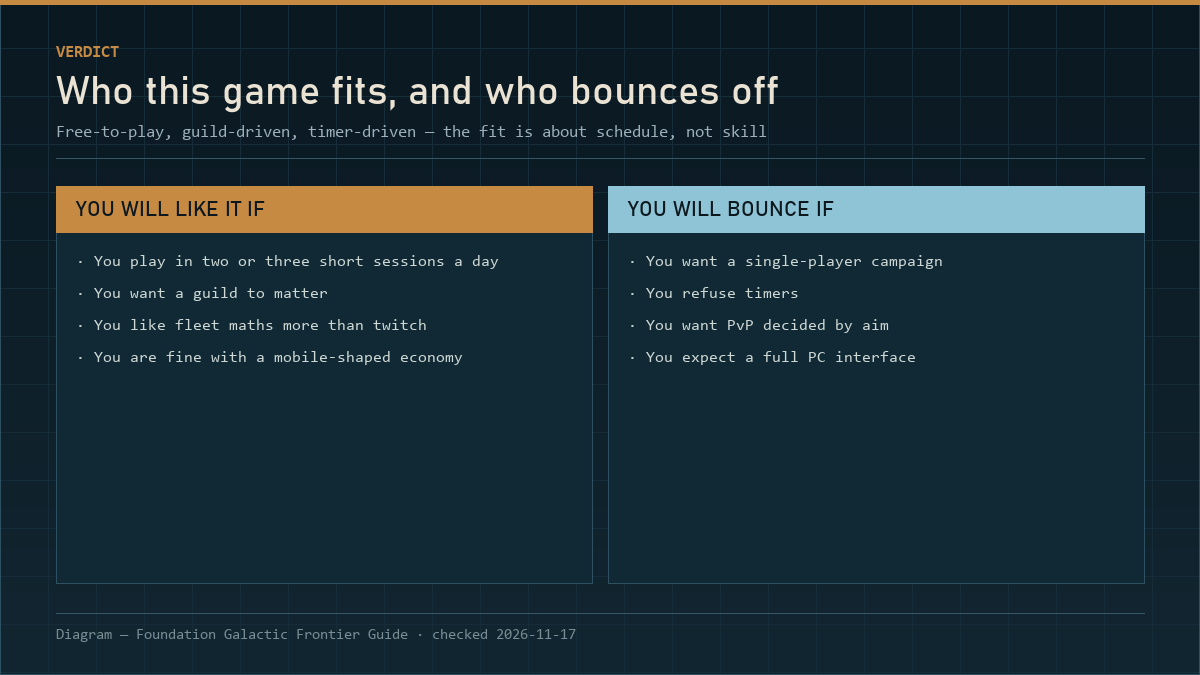
It is worth playing if you can open it two or three times a day and will join a guild; those two habits decide most of the experience. It is a poor fit if you want a single-player campaign, refuse timers, or expect a PC-native interface.
Foundation: Galactic Frontier is free, guild-driven, timer-driven, and honest about being a mobile game with a PC client. Whether it is worth your time in November 2026 depends on three things that have nothing to do with review scores: how often you can open it, whether you will join a guild, and whether timers annoy you or organise you.
Here is the fit test, in the order that matters.
The 30-second verdict
| If this is you | Play it | Why |
|---|---|---|
| You open a game two or three times a day for 15–40 minutes | Yes | The whole economy is built around short, frequent sessions |
| You want a guild to matter | Yes | Ports, rallies and Stellar Halo are guild systems, not solo content |
| You like fleet composition more than reflexes | Yes | The depth is in energy types, Champion synergy and Core Components |
| You want a single-player story campaign | No | Story exists, but it is an on-ramp, not the game |
| You refuse timers and energy systems | No | They are the core loop, not a wrapper |
| You want PvP decided by aim | No | Fleet combat resolves on composition and matchup; ground combat is the twitch layer |
| You expect a PC-shaped interface | Maybe | It is a port. The UI assumes touch first |
What "free" actually means here
The official FAQ is explicit: the game is free to play, all core gameplay systems and story content are available at no cost, and optional purchases are for cosmetic customisation, progression boosts and faster access to certain Champions or ships. No purchase is required to experience the core content.
That is a real free-to-play boundary, and it is worth taking seriously: you can play the entire progression without paying. What money buys is time, and the question is whether your time is worth more than the price of a boost. That is a personal calculation, not a moral one — our spending page handles it without inventing prices.
What free does not mean: no pressure. Timers, energy-style Action Points and event windows all create the usual soft pressure to spend. If that pressure bothers you, no amount of "it's optional" will fix it.
The three costs nobody lists
1. Attention, twice a day
Timers run offline, which is the game's best feature and its biggest ask. A single long session on Saturday cannot replace six short sessions across the week: Action Points cap, Trade Attempts cap, and the guild block is time-sensitive. If your schedule cannot produce two touch points a day, your progress will be visibly slower than someone who can.
2. Social dependency
The official 10 Tips guide puts "join a guild" at number one, and the data agrees with it: only 27.5% of players have the guild achievement. Guilds gate port buffs, rallies (the only documented source of Prismatic Cores), Stellar Halo and Home Port options on guild ports.
You can play solo. You will be playing a thinner version of the game, and you will hit walls that guild members do not.
3. A mobile-shaped interface
Ground combat is third-person tactical with a three-Champion squad, and it was designed for a touchscreen. On PC it works, but it does not feel like a PC tactics game. If your benchmark is a native PC strategy title, the port will feel like a port.
What the game is genuinely good at
- Fleet composition has real decisions. Three energy types, a counter ring with a documented +5% bonus, Champion synergy at +10% / +20%, and a Core Component that lets you switch your whole fleet's Style before a fight. That is a compact, legible system with actual tradeoffs.
- Guild warfare is structured. Port wars have published rules: who can declare, what territory you need, a one-hour assault window, and a final-blow victory condition. That is more legible than most mobile PvP.
- The late game is dated and knowable. Week 27, 60% research, six reactors, Lvl 35, fourth queue at 33 — you can plan months ahead instead of guessing.
- Cross-platform actually works. One account across Windows, iOS, Android and macOS with shared progression, per the official FAQ.
Where it will frustrate you
| Friction | What it looks like | Can you fix it? |
|---|---|---|
| Thin onboarding | The tutorial covers the first hour; the Epoch tree has none | Read the Epoch guide before week 27 |
| Guild dependency | No rally means no Prismatic Cores | Join an active guild, or accept slower cores |
| Timer walls | Waiting for a building to finish is the game | Queue long builds before logging off |
| Port politics | Declarations need a Chairman or Executive online | Be in a guild that staffs those ranks |
| PC expectation gap | UI and ground combat feel touch-first | Play on a phone if that bothers you |
| Small English wiki coverage | Fandom has ~10 thin pages | Use this site and the official guides |
The comparison you should actually make
Not "is this better than other space games" — it is a different genre. The honest comparison is: does this fit the way I already use my phone or PC?
If you already play a base-builder or a guild-based MMO, you know the rhythm and the question is theme. If you have never played one, this is a competent example with a real IP attached and an unusually legible late game.
If you want a single-player narrative strategy game in the Foundation universe, this is not it, and no update will make it that.
A fair one-week test
- Play the first hour using the beginner sequence, not free exploration.
- Join a guild on day one. If you skip this, you are testing a different game.
- Settle a Home Port and run your Trade Attempts to zero once.
- Play three days. If the timer rhythm feels like a chore by day three, it will feel worse by day thirty.
- Do not spend before day seven. The free experience is complete enough to judge.
Next
- Spending: what money buys, and what has no published price — the monetisation boundary in detail.
- Platforms and system requirements — the Windows minimums, and what mobile needs.
- Reviews and player count — why 62% from 152 reviews is not a verdict.