
Reviews and player count: how to read 152 reviews and 206 players
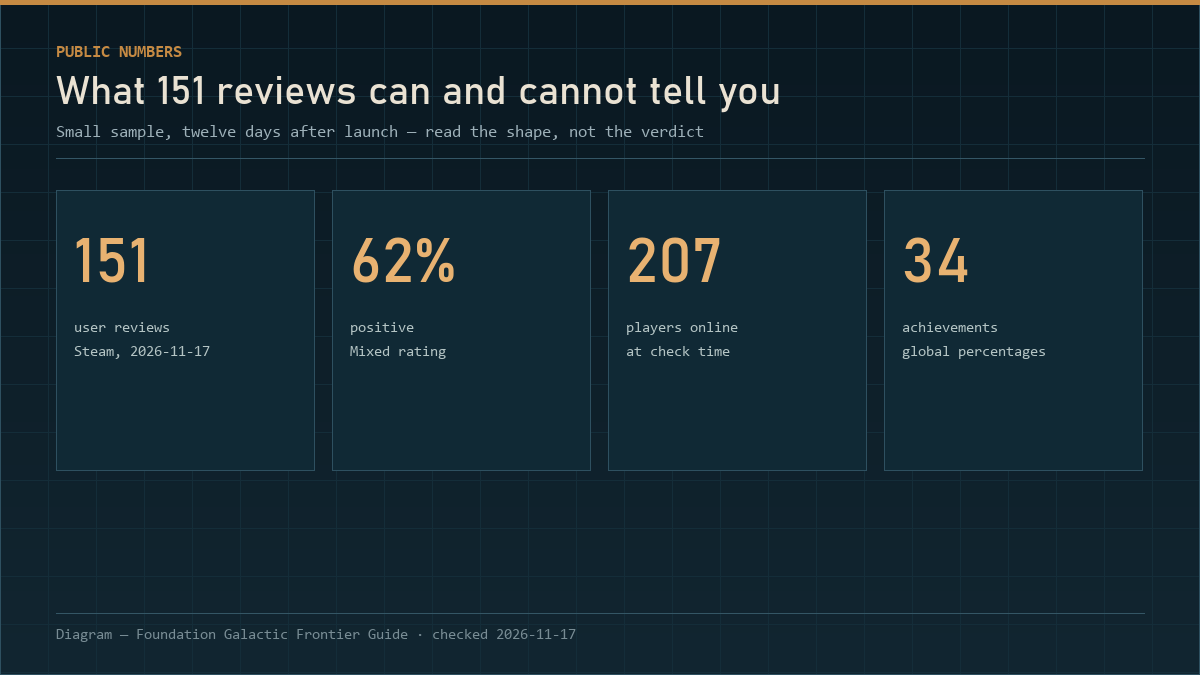
At check time the store showed 152 reviews at 62% positive (Mixed) and 206 players in-game on Steam. That is twelve days of first impressions from one platform of a cross-platform game: a sample of early reaction, not a verdict on the game.
On 2026-11-17, twelve days after the Steam release, Foundation: Galactic Frontier had 152 user reviews, 62% of them positive, a Mixed rating, and 206 players in-game at the moment of the check.
Those four numbers get quoted constantly and read badly. They are also a very small sample from a very short window, and this page is about what they can and cannot support.
The numbers, with their sources
| Metric | Value | Where it comes from |
|---|---|---|
| User reviews | 152 | Steam store review summary |
| Positive share | 62% | Same block (data-tooltip-html) |
| Rating band | Mixed | Steam store |
| Players in-game | 206 | Steam current-players API |
| Achievements | 34 | Steam achievement API |
| Days since launch | 12 | Store release date, Nov 5, 2026 |
At 62%, the split is roughly 94 positive and 58 negative reviews. The assessment page turns that into a fit test instead of a score. That is not "everyone hates it" and it is not "everyone loves it". It is a genuinely divided early audience, and the size of that audience is the first thing to weigh.
What a Mixed rating means on Steam
Steam's rating bands are mechanical, not editorial:
- Overwhelmingly Positive — 95% positive or more
- Very Positive — 80% to 94%
- Positive — 70% to 79%
- Mixed — 40% to 69%
- Negative — 20% to 39%
At 62%, this game sits in the middle of the Mixed band. It would need about 8 more positive reviews (and no new negatives) to cross into Positive — which is a way of saying the rating is fragile, not settled.
Why 152 reviews is a small number
For a free-to-play game with cross-platform play, 152 reviews is a rounding error against the install base. Three biases follow:
- Self-selection. People who write reviews are the ones with a strong reaction. A 62% split among motivated reviewers can coexist with a much happier silent majority, or a much unhappier one.
- Port shock. A year-old mobile game arriving on Steam attracts PC players who expect a PC game. Their complaints are about the shape of the game, not its quality, and they weigh heavily in a 152-review sample.
- Launch window. Twelve days is not enough time to reach the mid-game, let alone the Epoch content. Reviews written in week one describe the tutorial.
None of that makes the reviews wrong. It makes them a sample of first impressions, which is a different measurement from "is this game good".
The player count, read properly
206 concurrent players is the number people quote to declare a game dead. Two corrections:
- Steam's concurrent count only covers the Steam build. The game is cross-platform with iOS, Android and macOS, and the mobile build has been live for a year. Steam concurrency is not total concurrency.
- 206 concurrent on a twelve-day-old port of a mobile game is not a signal about the game's health; it is a signal about how many PC players have adopted it so far.
What would be a signal: a sustained decline over a month, or a spike pattern that never returns to baseline. We do not have that data yet, and we will not pretend a single reading is a trend.
What the review text is probably arguing about
We are not going to quote reviews we cannot verify line by line. What the numbers and the platform split do support:
| Complaint shape | Why it is likely |
|---|---|
| "It's a mobile game" | Because it is one, with a PC client. Timers, energy systems and shop structure are mobile grammar |
| "The tutorial is thin" | The game assumes a year of accumulated systems; the Epoch tree has no onboarding at all |
| "It's pay-to-win" | It has in-app purchases for progression boosts and faster Champion access. Whether that is "win" depends on your definition |
| "Combat is shallow" | Fleet combat is a counter system with three types and a 5% bonus, not a tactical sim. Depth is in composition, not execution |
| "It's a guild game" | It is. 27.5% of players have joined a guild; the game is designed around the other 72.5% joining one |
Those are structural observations, and you can check each one against the official material rather than against a review score.
How to use this page if you are deciding
- Ignore the percentage, read the count. 152 reviews is not a verdict. It is an early sample.
- Ask what the reviewers were doing. Week-one reviews describe the tutorial, not the Epoch tree.
- Check whether the complaints apply to you. "It's a mobile game" is a dealbreaker for some players and irrelevant to others.
- Watch the trend, not the snapshot. If the count doubles and the percentage holds, that means something. Today it does not.
What would change our read
A single snapshot is weak evidence. Three developments would make the picture clearer, and we will update this page if they happen:
| Development | What it would tell us |
|---|---|
| Review count passes ~1,000 | The sample stops being noise and the percentage starts meaning something |
| The percentage moves more than five points | A patch, a pricing change or a review campaign — all worth investigating |
| Concurrent players hold a stable weekly pattern | Whether the PC audience has a habit or just curiosity |
Until then, treat the numbers as a weather report for one morning, not a climate.
Where to look instead of the score
- The achievement funnel on the achievement page measures actual player behaviour, not sentiment.
- The official guides tell you what the game intends to be, which is the standard any review is implicitly judging.
- Your own first week, using the beginner sequence — the only sample that includes you.
A note on review campaigns
Free-to-play launches attract coordinated review activity in both directions, and twelve days is exactly the window when that distortion is largest. We have no evidence of a campaign here, and we are not going to imply one. The point is narrower: at 152 reviews, a handful of organised votes moves the percentage by several points, which is another reason not to treat 62% as a measurement of quality.
Next
- Is it worth playing in 2026? — the fit test, not the review score.
- Spending: what money buys and what has no published price — the monetisation boundary.
- Steam vs mobile — why Steam concurrency is not the whole player base.