
Combat and formation: space fleets versus ground squads
Space battles are decided by composition: energy counter, Champion synergy and Core Component Style, with skills firing left to right. Ground battles use a three-Champion squad where role coverage beats synergy stacking and ability text matters more than raw stats.
There are two combat layers in Foundation: Galactic Frontier, and they reward different things. Space battles are fleet composition: energy types, Champion synergy, a Flagship Style you can switch. Ground battles are a three-Champion squad in third-person tactical combat. Treating one like the other is the most common tactical mistake.
The two layers, side by side
| Space fleet combat | Ground squad combat | |
|---|---|---|
| What you control | Fleet composition, Style, skill order | Three Champions, positioning, timing |
| What decides fights | Energy Type matchup (+5%), Champion synergy (+10%/+20%), Core Component Style | Champion abilities, squad roles, execution |
| Where it happens | Systems, ports, fleet missions | Planetary surfaces and space ruins |
| Named example | Port assaults, Ascendancy hunts | The "Kaboom, Robots" event type |
The official FAQ describes the split directly: space gameplay is fleet combat and mothership management with a tactical counter system around three weapon types, while ground gameplay deploys a three-Champion squad for third-person tactical encounters.
Space: the formation is the tactic
There is no aiming in fleet combat. What you have is a set of multipliers, and the order you apply them is fixed: If any of those four steps is unfamiliar, read the fleet power breakdown first; this page assumes it.
- Pick the Energy Type that counters the enemy. Beam beats Kinetic, Kinetic beats Ionic, Ionic beats Beam. Winning gives +5% damage.
- Field three Champions of that type. Two matching gives +10% ATK/DEF/INT, three gives +20% — worth more than the counter bonus.
- Set the Core Component so your fleet's Style counters theirs. Another +5% when you have the advantage.
- Order the Champions left to right so buffs and debuffs resolve before damage.
Step 2 is where most fleets lose. A player who owns five strong Champions of mixed types fields two of one type and loses the 20% tier — which costs more than the 5% they gained by countering.
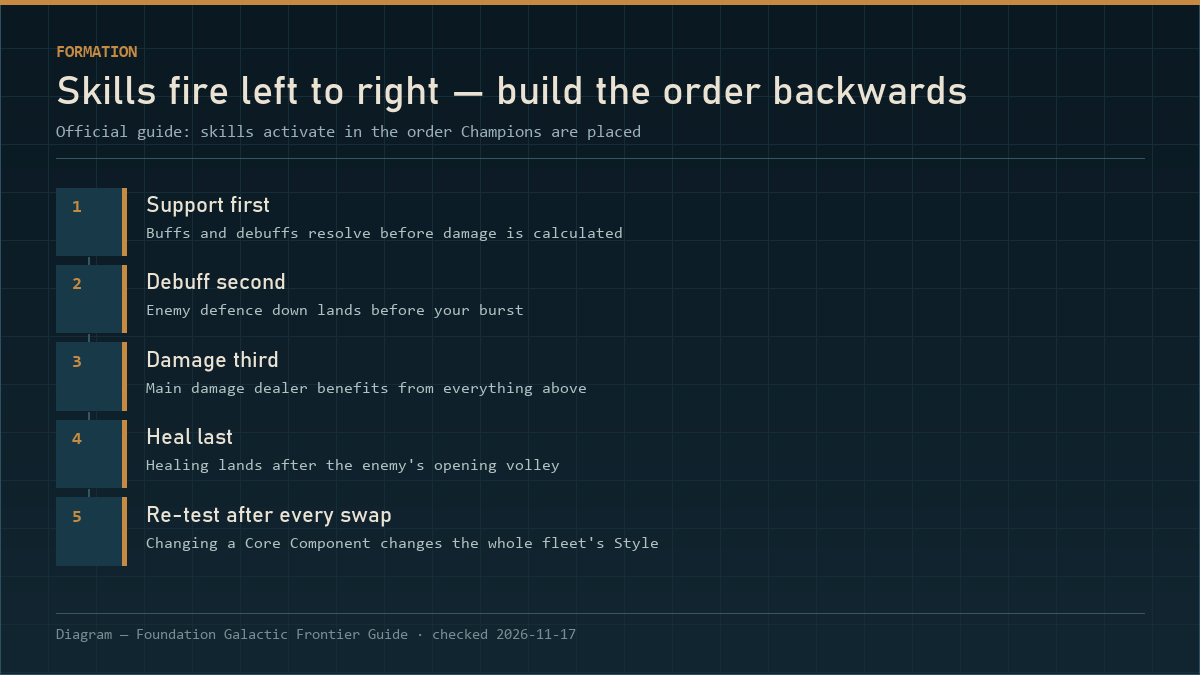
Skill order: the free multiplier
The official fleet power guide states that skills activate in placement order, left to right. It even gives the pattern: put support or debuff Champions first so their skills fire before your damage dealers.
| Slot | Role | Why here |
|---|---|---|
| 1 | Buffer | ATK/DEF/INT buffs land before any damage is calculated |
| 2 | Debuffer | Enemy defence reduction applies to every hit after it |
| 3 | Main damage | Benefits from slots 1 and 2 |
| 4 | Secondary damage or healer | Cleanup, or healing after the opening exchange |
If you change a Champion and your win rate drops, check the order before you check the power score. The same logic applies to the ground squad, where a Champion's role matters more than its level. Moving a buffer from slot 1 to slot 4 can lose a fight you would otherwise win.
Ground: three Champions, different rules
Ground combat is a squad of three, not a fleet. Two things change:
- Role coverage beats synergy stacking. You want damage, sustain and control in three slots, because there is no fourth slot to patch a hole.
- Champion abilities matter more than raw stats. A Champion whose ability does nothing in a ground scenario is a wasted slot regardless of level.
The official guide's example is explicit: some Champions excel in ground combat during events like Kaboom, Robots, while others are better in space. That means a Champion you dismissed for fleet duty may be your best ground pick — and vice versa.
Building a ground trio without a tier list
We do not publish Champion rankings, because FunPlus has not published stats or a roster with rarities. What you can do instead:
- Read the ability text on each Champion. Decide whether it deals damage, heals, shields or controls.
- Fill three slots: one damage, one sustain, one control or debuff. If a Champion does two, you have flexibility in the third slot.
- Check INT on your healer. INT boosts healing for healing-role Champions, per the official stat description, so a high-INT healer is doing its job.
- Test on a low-stakes ground node before committing to an event run.
- Keep the trio together. Swapping one Champion between runs resets your sense of what the squad can survive.
What to do before a port war
Port wars are fleet combat with a hard clock: a one-hour window to begin the assault, and the final blow on Fortress HP decides ownership. The full declaration rules live on the port occupation page; this is the fleet-side checklist.
A pre-war checklist that follows from the rules:
- Confirm your fleet is three-of-a-type. Do not enter a war with a mixed fleet because your strongest Champions are scattered.
- Set the Core Component to counter the defending Style, if you know it.
- Reorder skills so buffs land first.
- Save one burst for the end. The final blow decides the port, so a fleet that can hit hard late is worth more than one that front-loads everything.
- Stay for the hour. Contribution without presence earns participation rewards at best.
Common formation mistakes
| Mistake | Cost | Fix |
|---|---|---|
| Strongest Champions regardless of type | Lose the 20% synergy tier | Build in threes |
| Breaking synergy for a 5% counter | Net loss of about 15% across three stats | Counter only when synergy is equal |
| Ignoring skill order | Buffs land after damage | Support left, damage right |
| A fleet Champion in a ground event | Wasted slot | Keep a dedicated ground trio |
Next
- Fleet power: the maths behind the multipliers — the official rules in full.
- Port occupation — where fleet composition meets a one-hour clock.
- Flagships and Champions — how to invest in the units you are fielding.